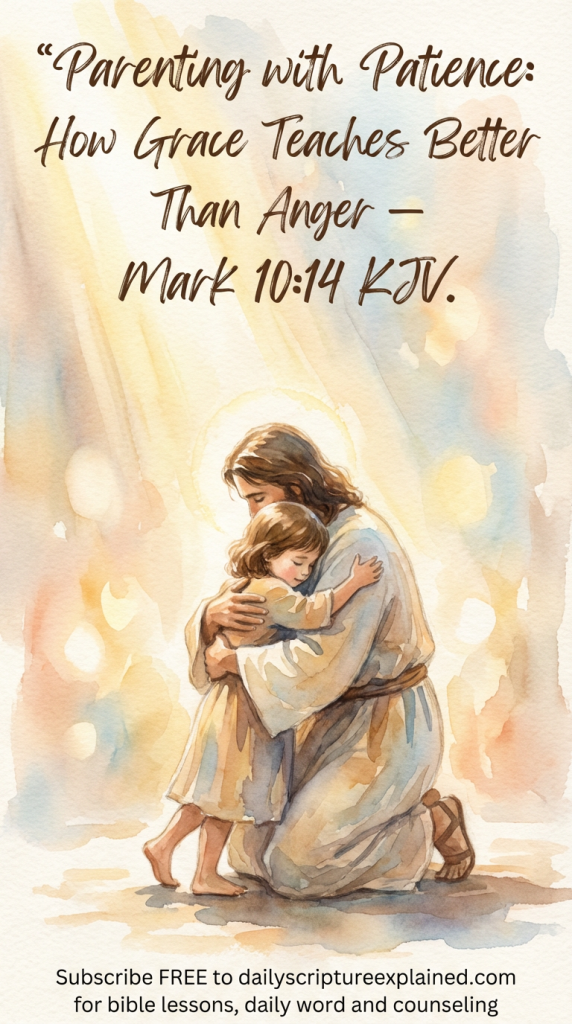
Parenting with Patience: How Grace Teaches Better Than Anger” Mark 10:14 KJV
Translate this page and site into over 100 languages by using the Google Translate Menu on the HOME PAGE. Please subscribe to our YouTube channel and this blog. It is free. It helps.
Disclosure: Artwork is conceptual for teaching; not literal depictions of Jesus, heaven, or hell.
Children learn more from your calm than your correction.
Scripture: Mark 10:14 KJV — ““But when Jesus saw it, he was much displeased, and said unto them, Suffer the little children to come unto me, and forbid them not: for of such is the kingdom of God.”.”

Alt tag: #Parenting with love
🌿 Grace: The Teaching Method Jesus Used
When the disciples tried to push the children away, Jesus didn’t yell, intimidate, or shame them. He said, “Let the children come.”
He welcomed them with gentleness, honor, and patience.
This teaches a powerful truth: Children learn best from grace—not from fear.
Grace does not mean there are no rules. Grace means rules with love, limits with calm, and discipline with dignity.
Jesus never used anger to correct His disciples. Even when they failed, He taught, guided, and redirected them with patience. Parenting should reflect that same love.
💔 The Harsh Reality: What Yelling and Anger Do to Children
From a professional counseling and developmental psychology perspective, the research is overwhelming:
📌 1. Yelling causes stress damage similar to physical punishment
Studies from the University of Pittsburgh and Harvard Medical School show:
-
Children who are yelled at regularly have higher cortisol levels (stress hormone).
-
Their brains respond the same way as when exposed to physical pain.
-
They develop “fight, flight, or freeze” responses during conflict.
📌 2. Frequent yelling affects brain development
A 2019 study in the journal Child Development found:
-
Harsh verbal discipline changes the prefrontal cortex and amygdala, the areas of the brain linked to decision-making and emotional regulation.
-
Teens raised in yelling environments show the same brain patterns as those exposed to constant fear.
📌 3. Children raised in anger become insecure teens
Research from the University of Montreal found:
-
Teens exposed to yelling are more likely to struggle with anxiety, depression, and self-esteem issues.
-
They feel “never good enough” and disconnect emotionally from parents.
💥 Effects on the Parent–Adult Child Relationship
Many parents believe yelling is “normal” or “how they were raised.”
But long-term studies show the truth:
📌 Emotional distance
Adult children raised in anger often avoid their parents to protect their mental health.
📌 Distrust
When parents discipline out of mood instead of guidance, children learn: “Love is unstable.”
📌 Low-contact or no-contact relationships
Family therapists consistently report that:
-
Adult children who were yelled at, belittled, or hit without emotional repair
-
Are more likely to pull away completely in adulthood.
This is why many seniors today feel abandoned. Some spent years raising kids in fear—not relationship. Children grow up, remember the pain, and emotionally detach for survival.
Alt tag: #Train a child
🕊️ Jesus Warned Us About This Type of Disconnect
Jesus told Peter something prophetic about aging: John 21:18 KJV
“When thou shalt be old, thou shalt stretch forth thy hands, and another shall gird thee, and carry thee whither thou wouldest not.”
Meaning: When you are old, others will care for you—and you may be taken places you don’t want to go.
In a modern counseling context, this can apply to parents too:
Your relationship with your children in later years is shaped by how you treated them when they were young.
Children raised in grace come back. Children raised in fear often run from the pain.
❤️ What Happens to Parents Who Yell or name call?
📌 1. Increased guilt
Many parents secretly feel regret after yelling but don’t know how to stop.
📌 2. Relationship strain
Parents start feeling like their child “doesn’t like them,” but in reality, the child feels unsafe.
📌 3. Emotional burnout
Yelling parents are more stressed, irritable, and overwhelmed. Anger drains the home. Grace strengthens it.

Alt tag: #trainachild
✅ 1. What Does the Bible Really Mean by “Don’t Spare the Rod”?
“He that spareth his rod hateth his son: but he that loveth him chasteneth him betimes.”
Many people think this means beating a child, but that is NOT what the Hebrew text teaches.
✔ The “rod” in Proverbs was a shepherd’s rod
It was used to:
-
guide
-
correct
-
protect
-
keep the sheep close
-
tap lightly to redirect
A shepherd did NOT beat sheep. If a shepherd hit a sheep in anger, the sheep would run away and never trust him again.
✔ Biblical correction = guidance, not abuse
The rod symbolizes:
-
firm boundaries
-
wise correction
-
loving discipline
-
preventing danger
Not yelling…Not emotional punishment…Not hitting out of anger.
It is better translated as “loving guidance with consistent correction.”
✅ 2. The biblical story about a father who refused to discipline his sons — and whose sons later died in war — Eli, the high priest.
📖 1 Samuel 2–4 KJV : Eli’s Sons — Hophni & Phinehas
-
They were priests, responsible for God’s house.
-
They sinned publicly and repeatedly.
-
They disrespected God and manipulated offerings.
-
Eli scolded them verbally but never disciplined or restrained them.
God said this about Eli:1 Samuel 3:13 (KJV)
“His sons made themselves vile, and he restrained them not.”
Because Eli refused to discipline or guide them:
-
They grew worse
-
They hardened their hearts
-
They dishonored God
-
They became spiritually blind and were killed in war.
✅ 3. There Is a Second Similar Story: David & Adonijah
Another father who failed to discipline his son Adonijah was King David. 1 Kings 1:6 (KJV)
“His father had not displeased him at any time in saying, Why hast thou done so?”
David never corrected Adonijah.
No limits.
No guidance.
No boundaries.
Adonijah later rebelled and tried to take the throne. Eventually, he died because of his rebellion (1 Kings 2:24–25).
🔍Both Biblical Stories Teach a Biblical Pattern:
❌ Lack of discipline → destruction
✔ Loving discipline → safety
But biblical discipline is:
-
calm
-
controlled
-
consistent
-
protective
-
based on teaching
-
not based on anger or emotional reactions
Not once did God allow abusive parenting, rage, or violence to be called “discipline.”
🌱 What the Bible Actually Teaches About Discipline
Many adults were raised thinking:
“If I don’t yell, they won’t listen.” or “I hit them because I love them.” But that is not biblical discipline.
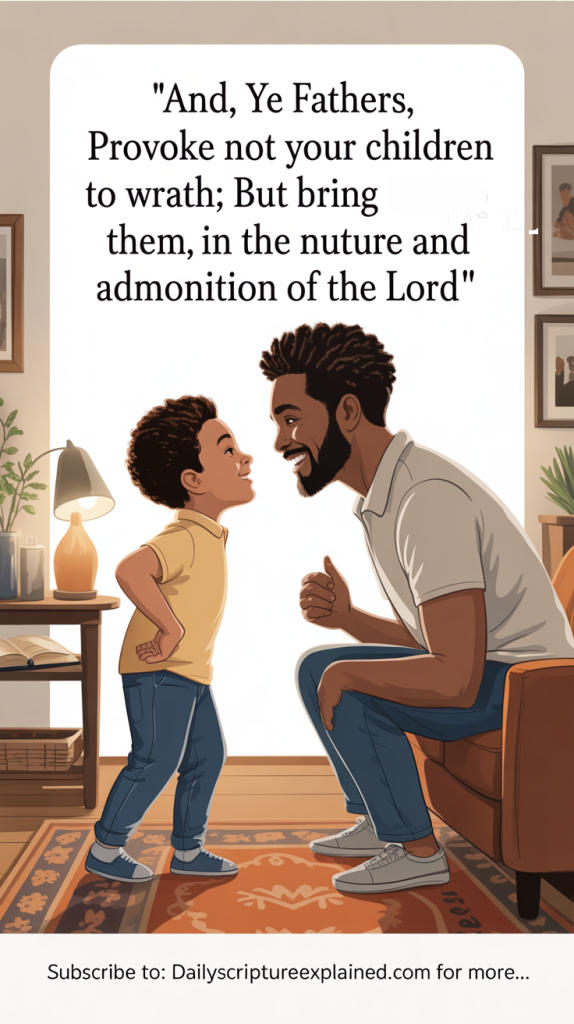
Ephesians 6:4 KJV “Fathers, provoke not your children to wrath: but bring them up in the nurture and admonition of the Lord.”
This means:
-
Don’t create anger in your child
-
Teach with calm instruction
-
Use discipline that guides, not harms
Anger provokes. Grace instructs.
🌿 Grace-Based Parenting: Stronger Than Anger
Grace-based discipline includes:
✔ Clear rules
✔ Calm communication
✔ Consistent consequences
✔ Emotional safety
✔ Repairing after mistakes
✔ Understanding development
✔ Modeling Christ-like behavior
Grace does not remove responsibility. Grace teaches responsibility with love.
Alt tag: #Parenting a child
💡 Why Grace Works Better
Psychology and Scripture agree:
-
Children imitate what they see, not what they hear yelled at them.
-
Grace regulates the nervous system, making learning possible.
-
Calm discipline teaches problem-solving instead of fear.
-
Grace strengthens attachment—the foundation for lifelong respect.
Grace builds strong adults. Anger builds distant ones.
💬 Takeaway Message
Grace doesn’t spoil children—it strengthens them.
Anger doesn’t shape children— it scars them.
Parent with the fruit of the Spirit, not the weight of your frustration.
💭 Reflection:
What part of my parenting needs more grace—and what part of my anger do I need God to heal?
Do your children see the patience of Christ in the way you correct them?
Here are three clear, practical, biblical + counselor-approved action steps that parents can take to check anger and guide their children with better direction.
✅ Action Step 1: Pause Before Responding — “Slow to Anger, Quick to Listen”
Scripture: James 1:19 KJV — “Let every man be swift to hear, slow to speak, slow to wrath.”
Before speaking, take a 5–10 second pause to calm your nervous system.
This prevents impulsive reactions and gives you time to choose grace over frustration.
How to do it:
-
Take one deep breath.
-
Ask yourself: “Is this about the child… or my own stress?”
-
Respond only when you can speak in a calm tone.
This single shift dramatically reduces yelling and increases connection.
✅ Action Step 2: Set Clear, Consistent Boundaries—Not “Emotional Rules”
Scripture: Ephesians 6:4 KJV — “Provoke not your children to wrath: but bring them up in the nurture and admonition of the Lord.”
Children misbehave more when expectations are unclear.
Parents get angrier when they rely on emotions instead of structure.
How to do it:
-
Define 3–5 household rules.
-
Explain calmly what happens if the rule is broken.
-
Follow through every time—calmly and consistently.
Consistency reduces anger because the child already knows what to expect. It becomes guidance, not punishment.
✅ Action Step 3: Repair After Conflict — “Grace Teaches Better Than Shame”
Scripture: Colossians 3:21 KJV — “Fathers, provoke not your children to anger, lest they be discouraged.”
After a heated moment, repair the relationship with your child.
Children remember repair more than the conflict.
How to do it:
-
Sit with your child after things calm down.
-
Say: “I love you. Let’s talk about what happened and what we both can do better next time.”
-
Reassure them of your love and your desire to teach, not punish.
Repair builds trust. Trust builds obedience. Obedience grows from connection, not fear.

Alt tag: #angry words, angry world
🙏❤️🔥 Do you need someone to talk to?
Daily Scripture Explained Online Bible( KJV) Counseling Service 🙏 Donation Based Ministry:
Disclosure: No fees. If you find value in your session, donations are welcome. Email-based now; live chat and office hours are coming soon.
Find hope, clarity, and peace. We share guidance from the King James Bible.
“Thy word is a lamp unto my feet, and a light unto my path.” — Psalm 119:105 (KJV)
“For by wise counsel thou shalt make thy war: and in multitude of counsellors there is safety.” – Proverbs 24:6
Keywords: parenting, patience, grace, love, faith, family, children, Christian parenting, teaching, example, peace, home, self-control, discipleship, wisdom
Hashtags: #ParentingWithPatience #Faith #Grace #ChristianParenting #Family #Love #Patience #PeacefulHome #TeachWithGrace #FaithJourney #Wisdom #SelfControl #GodlyParenting #LoveLikeJesus #DailyDevotion
👍Disclosure: Below graphics are not affiliated links. There is nothing to buy. Take the challenge: 45 Days to Learn the Gospel Challenge

alt tag: #45 days to learn the gospe challenge
Romans 10:17 KJV “So then faith cometh by hearing, and hearing by the word of God.”

Alt tag: #Offer of Salvation John 315 Final
A CALL TO SALVATION:
John 3:16 “For God so loved the world, that he gave his only begotten Son, that whosoever believeth in him should not perish, but have everlasting life.”
Romans 10:9-109That if thou shalt confess with thy mouth the Lord Jesus, and shalt believe in thine heart that God hath raised him from the dead, thou shalt be saved. 10For with the heart man believeth unto righteousness, and with the mouth, confession is made unto salvation.
John 3:5-65Jesus answered, Verily, verily, I say unto thee, Except a man be born of water and of the Spirit, he cannot enter into the kingdom of God. 6That which is born of the flesh is flesh, and that which is born of the Spirit is spirit. 7